The road from Nairobi to the Masai Mara covers roughly 270 kilometers and takes anywhere from five to eight hours depending on the route chosen, road conditions on the day, and how many times the vehicle stops. Every traveler heading overland faces the same decision before setting out: shared shuttle vs private vehicle. The two options differ in price, comfort, departure timing, and who each one genuinely suits. This guide lays out the facts across all those dimensions so you can match the transfer type to the reality of your trip.
Quick Comparison: Shared Shuttle vs Private Vehicle
| Factor | Shared Shuttle | Private Vehicle |
|---|---|---|
| Cost | $30 to $80 per person | $150 to $300+ per vehicle |
| Departure time | Fixed (typically 7am to 8am from Nairobi) | Set to your schedule |
| Routing | Established stops and shared route | Direct to your camp |
| Comfort | Variable by vehicle age and load | Typically a 4×4 Land Cruiser or Defender |
| Journey time | 5 to 8 hours including stops | 5 to 7 hours direct |
| Privacy | Shared with other passengers | Your group only |
| Luggage | Limited by shared space | Full cargo capacity |
| Flexibility | Fixed schedule and stops | Stop anywhere, any time |
| Return | Fixed days and times | Arranged around your departure |
| Best for | Solo travelers and budget-conscious couples | Families, groups, time-sensitive itineraries |
How the Shared Shuttle Works
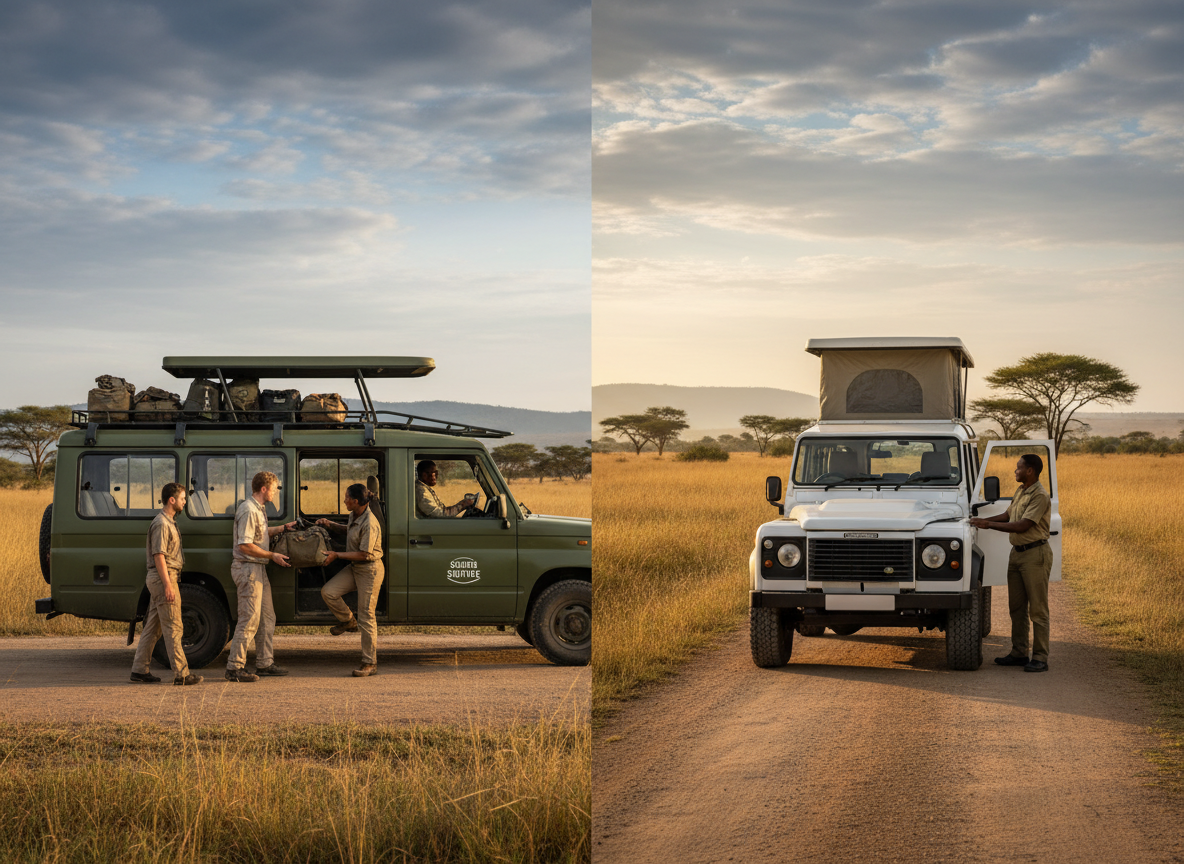
Shared shuttles on the Nairobi to Masai Mara route collect passengers from city hotels and central guesthouses, typically between 7am and 8am. The vehicle follows a predetermined sequence: picking up passengers at multiple points across Nairobi before heading south on the Narok Road. Arrival at the Mara gate area generally falls between midday and 2pm, depending on road conditions and the number of drop-off stops along the way.
Operators use different vehicle types: minibuses known locally as matatus, small coaches, and occasionally shared Land Cruisers. That variation matters on the unpaved gravel and murram roads between Narok and the camps. A properly maintained shuttle with a manageable passenger count handles the approach roads reasonably well. An overloaded minibus making five or six stops on the same track is a substantially different experience.
Fares and What They Cover
One-way fares from Nairobi to the Masai Mara run from approximately $30 to $80 USD per person, depending on the operator and vehicle type. Return combinations are typically offered at a discount. For solo travelers or couples where every dollar of the travel budget matters, that price point represents the lowest-cost overland option available on this route.
Where Shared Shuttles Fall Short
The fixed schedule is the hardest constraint to work around. If your flight lands late, or you want an early start to maximize your first game drive, the shuttle timetable cannot accommodate either. Additional limitations include:
- Multiple hotel pickups and camp drop-offs add time that a direct transfer avoids
- Luggage space is shared, and oversized bags or camera gear competes with other passengers’ kit
- Vehicle quality varies considerably across operators and is difficult to verify ahead of booking
- Some remote conservancy camps are not on the shuttle routing, requiring an additional transfer at the Sekenani gate
- You cannot ask the driver to stop at a viewpoint or adjust the route for any reason
How Private Vehicle Transfers Work
A private vehicle transfer means a dedicated 4×4, typically a Land Cruiser or Land Rover Defender, collects you from your Nairobi hotel or airport and drives you directly to your safari camp. No other passengers board. You set the departure time. You can stop at the Great Rift Valley escarpment viewpoints, a roadside market, or wherever the landscape calls for a pause.
The Nairobi to Masai Mara route has two main options. The Narok Road (A104) is paved to Narok and then transitions to gravel and murram for the remaining stretch to the camps. The Mai Mahiu Road via Naivasha is longer and adds roughly an hour to the journey but offers a more scenic descent into the Rift Valley. An experienced driver will read conditions on the day and advise accordingly.
The Cost in Context
Private vehicle transfers on this route cost between $150 and $300 USD per vehicle one way. For a solo traveler, that premium is real. For a family of four or a group of three, the per-person cost quickly converges with shuttle pricing, and in some configurations it falls below it. At that point, the comfort and flexibility of a private transfer carry no meaningful extra cost for the group.
What a Private Transfer Adds
Beyond the comfort of proper suspension on the Mara’s unpaved approach roads, a private transfer includes:
- Direct routing with no additional passenger stops
- Departure time aligned to your schedule, not a fixed timetable
- Full luggage capacity for camera gear, soft bags, and specialist equipment
- Driver-guides who will discuss the landscape, local context, and wildlife along the route
- The option to stop at the Rift Valley escarpment or any roadside scene without time pressure
- Return pickup arranged around your specific flight departures
Journey Time on Both Options
Both transfer types travel the same roads. The time difference between them comes almost entirely from the number of stops, not driving speed on the open road.
| Route | Approximate Time | Road Surface |
|---|---|---|
| Narok Road (A104) | 5 to 7 hours | Paved to Narok; gravel and murram from Narok to camp |
| Mai Mahiu Road via Naivasha | 6 to 8 hours | Longer route; scenic Rift Valley; similar final section |
A shared shuttle making multiple hotel pickups and sequential camp drop-offs typically adds 30 to 90 minutes beyond those baseline figures. A private vehicle heading to a single camp sits at the lower end of the range.
Which Traveler Each Option Suits
Shared Shuttle Works Best When
- Budget is the primary constraint and per-person savings matter more than flexibility
- Your camp is on an established shuttle routing
- Arrival timing is not tied to connecting flights or a same-day game drive start
- Your luggage fits within standard shared-vehicle limits
- Sharing the journey with other travelers is not a concern
Private Vehicle Works Best When
- You are traveling as a couple, family, or group of three or more, where the per-person cost reaches parity
- Your departure or arrival timing is tied to specific flights or onward connections
- Your camp is in a remote conservancy not served by the standard shuttle routing
- You carry camera equipment, drone gear, or anything oversized
- You want the overland drive to be part of the safari experience, with stops and commentary
Explorer Notes
Check the vehicle type before booking any shuttle. The gap between a shared Land Cruiser and a shared minibus is significant once the tarmac ends at Narok. Ask the operator directly what they use.
Confirm whether your camp is on the drop-off list. Not all camps and conservancies are served. If yours is not, the shuttle will leave you at a central gate and you will need to arrange an additional transfer, adding cost and time that were not in the original plan.
Ask whether private transfer pricing includes a driver-guide or driver only. The distinction matters. A driver-guide will narrate the Rift Valley descent and answer questions about the landscapes and communities along the way; a driver-only transfer is a quieter point-to-point ride.
Book early during peak season. Shared shuttle seats and private vehicles both fill quickly between July and October when Great Migration traffic is at its highest. Two weeks ahead is a minimum; a month ahead is safer.
Pack soft-sided bags wherever possible. Both shuttle holds and 4×4 cargo areas handle soft luggage more efficiently than rigid suitcases, and bags shift less on unpaved roads.
The overland drive from Nairobi to the Masai Mara is not just a transfer. The Rift Valley escarpment, the acacia-lined corridor into Narok, and the first open plains of the Mara are part of Kenya itself. The shared shuttle vs private vehicle decision determines how much of that you take in, and on whose schedule. Match the option to the actual shape of your group and itinerary, and the right answer is usually clear.
Every trip described here can be tailored: dates, budget, camps, and pace built around you.
Get a Personalised SafariFurther reading
- Magical Kenya (Kenya Tourism Board)
- Maasai Mara Wildlife Conservancies Association
- African Wildlife Foundation
More safari planning resources
- Nairobi to Maasai Mara route guide from Valley Safaris
- Compare Kenya safari packages on FindMySafari
- Rift Valley lakes map from Valley Safaris
- Interactive Maasai Mara map from Valley Safaris
Related guides: Private vs Shared Safari Vehicle in Kenya: The Real Price Difference.